
 By: Joe Dyken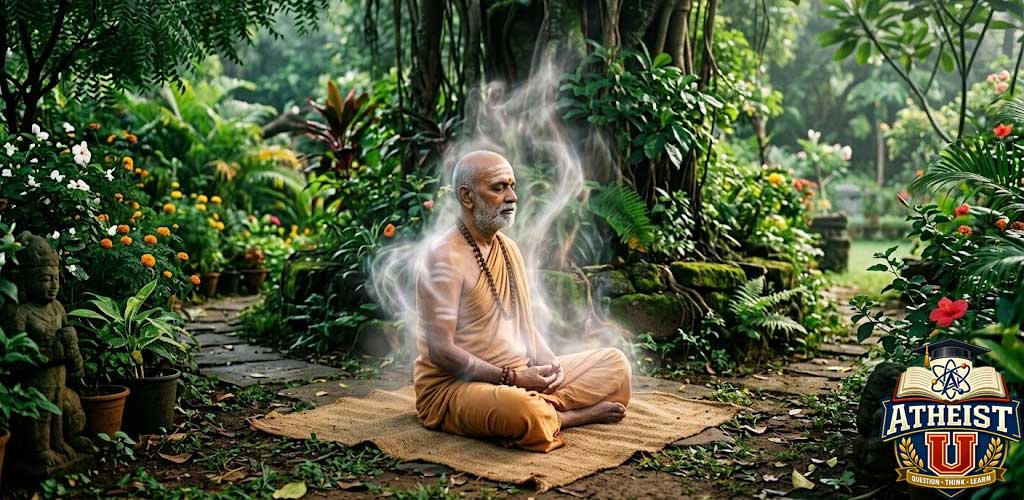
Reincarnation is one of those ideas that makes perfect sense inside a religious worldview, but becomes much harder to defend once it is judged by the standards of modern science.
In Hinduism, reincarnation is not just the idea that a person dies and then “comes back” as someone else. It is part of a much larger understanding of life, death, moral responsibility, and spiritual growth. Many Hindu traditions teach that the ātman, or enduring self, is not the same thing as the body. The body dies, but the self continues. That self carries karma, the moral consequences of one’s actions, into another life. This cycle of birth, death, and rebirth is often called saṃsāra, and the ultimate spiritual goal is moksha, or liberation from that cycle. In that sense, reincarnation helps explain why life is morally ordered, why suffering exists, and why spiritual discipline matters. It is not a random superstition. It is a serious philosophical answer to questions that every culture has wrestled with.
The difficulty comes when we ask whether reincarnation is scientifically plausible. Science works by looking for evidence that can be tested, measured, repeated, and explained through some known mechanism. Reincarnation would require some part of personal identity, memory, consciousness, or moral consequence to survive the death of the brain and transfer into another body. That is a very large claim. Modern neuroscience strongly connects memory, personality, and consciousness to the physical brain. When the brain is injured, memories can disappear, personality can change, and consciousness itself can be altered. That does not absolutely prove that nothing survives death, but it does make reincarnation very hard to explain scientifically.
We need to address a common argument involving energy. Some people point to the First Law of Thermodynamics and say that since energy cannot be destroyed, perhaps consciousness continues after death. The problem is that this confuses physical energy with personal identity. The energy in a body does continue in a physical sense. Heat dissipates, chemical energy breaks down, and the body returns to the environment. But that is not the same thing as memories, character, awareness, or a self. Those things depend, as far as science can currently tell, on organized brain activity. Once that organization is gone, science has no accepted explanation for how the information that makes a person “that person” could survive.
There have been serious attempts to study claims of past-life memories, especially involving young children. Researchers connected with the University of Virginia’s Division of Perceptual Studies, including Ian Stevenson and later Jim Tucker, have collected cases in which children claimed to remember previous lives. Some of these cases are interesting. A few include unusual fears, preferences, birthmarks, or details that researchers tried to compare with the life of a deceased person. These stories are not easy to dismiss casually, and they are worth studying as human experiences.
Still, they do not amount to scientific proof of reincarnation. Much of the evidence depends on family reports, interviews, memories, and interpretations after the fact. There are other possible explanations, including coincidence, suggestion, cultural expectations, hidden exposure to information, parental influence, false memory, or selective reporting. The strongest scientific problem is that these cases are not repeatable under controlled conditions. They are observations, not demonstrations of a known process. That matters because extraordinary claims require unusually strong evidence.
So the fairest conclusion is this: reincarnation is religiously and philosophically meaningful, especially within Hindu thought, but it is not scientifically established. It is coherent inside a worldview that sees consciousness as more than the brain and moral causation as extending beyond one lifetime. But under the current assumptions of mainstream science, there is no accepted mechanism for how a soul, memory, or personal identity would move from one body to another.
That does not mean science has answered every question about consciousness. It has not. Human awareness remains one of the hardest problems in philosophy and neuroscience. Future discoveries could change how we think about mind, matter, and identity. But based on what we know today, reincarnation belongs more to the realm of religion, philosophy, and metaphysics than to established science.
In plain terms, reincarnation may be spiritually plausible to a Hindu, philosophically interesting to a scholar, and emotionally meaningful to many people. But scientifically, it has not been proven, and it is not currently considered plausible by mainstream science.
Agree? Disagree?

