
 By: Joe Dyken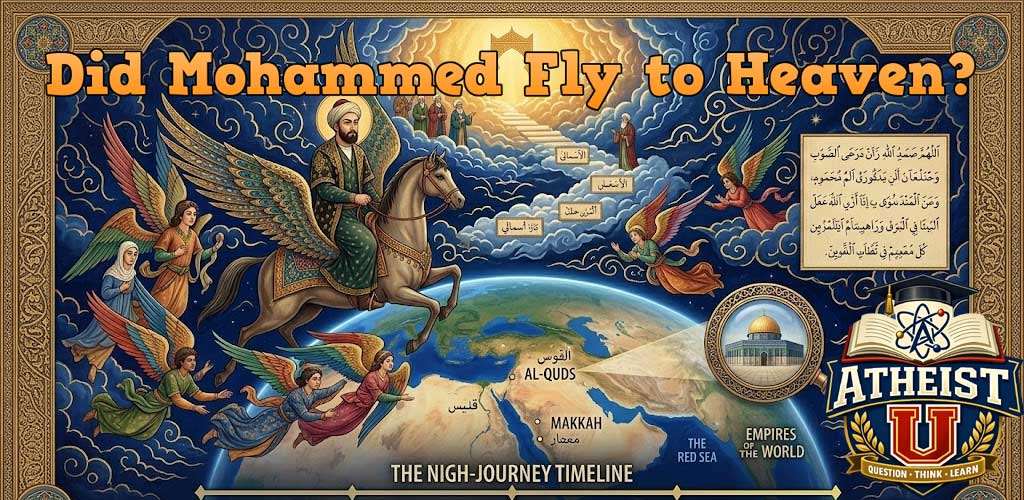
The tradition of Muhammad’s night journey and ascent to heaven, known as the Isrāʾ and Miʿrāj, appears to have started with a brief Qur’anic reference to a nighttime journey from the Sacred Mosque to the Farthest Mosque. That early reference is important, but it is also limited. It does not give the full later story of Muhammad riding al-Burāq, passing through the heavens, meeting earlier prophets, and receiving instructions about prayer. Those fuller details come from later Islamic tradition, especially hadith and biographical accounts.
From inside the Islamic faith, the event makes sense as a miracle. If God can intervene in history, then a supernatural journey is not impossible. For many Muslims, the story is not meant to be judged by ordinary travel, physics, or modern historical standards. It is a sign of Muhammad’s prophetic status, a link between Islam and earlier prophetic traditions, and an explanation for the central importance of daily prayer. Some Muslims have understood it as a literal bodily journey, while others have interpreted it as a vision or spiritual experience rather than a physical trip through the sky.
From a historian’s point of view, though, the question has to be handled differently. Historians can say that early Muslims believed Muhammad had a profound night journey or heavenly experience. They can study how that belief developed, why it mattered, and how it shaped Islamic worship and imagination. What historians cannot responsibly say is that Muhammad literally flew to heaven on a heavenly creature as a verified historical event. The story contains supernatural elements: a miraculous mount, instant travel, movement through the heavens, meetings with long-dead prophets, and contact with the divine. Those are faith claims, not claims that can be confirmed through ordinary historical evidence.
The accounts also show signs of development over time. The Qur’an gives the brief foundation. Later traditions fill in the details, including al-Burāq, the heavenly ascent, the meetings with prophets, and the reduction of the required prayers to five. That does not make the story meaningless or dishonest. It means the story functioned as sacred memory: a way for the early Muslim community to explain Muhammad’s authority, connect him with earlier prophets, and place Islam within a larger heavenly order.
So the harmonized historical judgment would be this: it is plausible that Muhammad or his early followers understood him to have had a powerful religious experience, whether visionary, spiritual, or later remembered as miraculous. It is also plausible that the story grew in detail as it was taught, repeated, and interpreted within the Muslim community. But from a strictly historical perspective, it is not plausible to treat the full account as a normal, verifiable event in which Muhammad physically flew to heaven. That conclusion belongs to faith, not history.
In plain terms: the story is historically significant because Muslims believed it, preserved it, and built meaning around it. It is not historically provable as a literal flight to heaven. A believer may accept it as a miracle. A historian would describe it as a sacred tradition built around a claimed religious experience.
Agree? Disagree?

