
 By:
By: 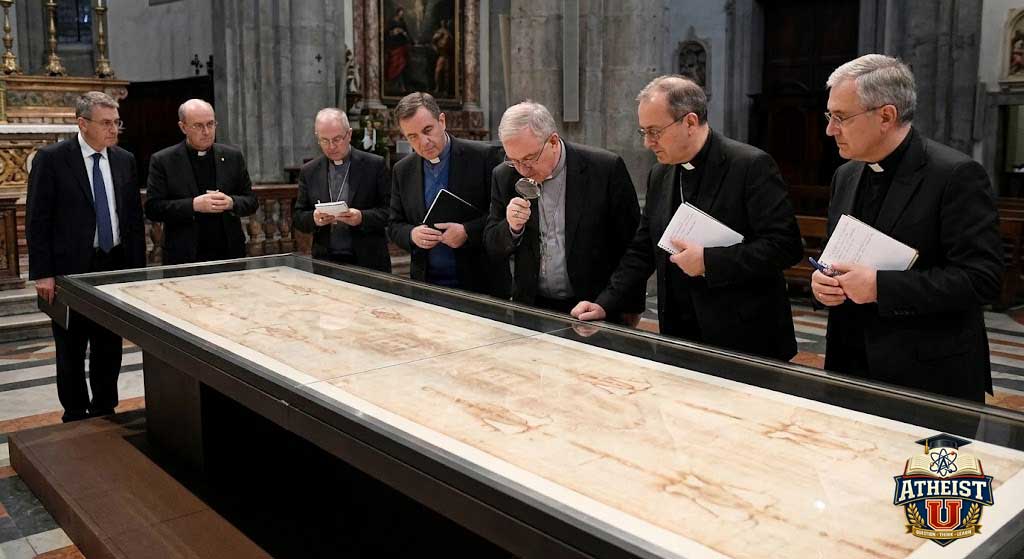
The Shroud of Turin is a linen cloth approximately 4.4 meters long and 1.1 meters wide, bearing faint frontal and dorsal images of a man who appears to have been crucified.
The figure displays wounds traditionally associated with the Gospel accounts of Jesus’s death, including injuries to the wrists or hands, feet, back, head, and side. Because of these features, many Christians believe the Shroud may be the burial cloth in which Jesus of Nazareth was wrapped after the crucifixion.
The Shroud is unquestionably an extraordinary religious and historical object. What remains unresolved is whether it is genuinely from first-century Jerusalem, whether it once covered an actual crucified person, and—most difficult of all—whether that person could be identified as Jesus.
The Historical Problem
The greatest historical obstacle to authenticity is the absence of a reliable chain of custody connecting the Shroud to first-century Jerusalem.
The cloth first appears securely in the historical record in Lirey, France, during the middle of the fourteenth century. It was associated with the French knight Geoffroi de Charny and was publicly displayed around 1355. This date is important because it closely corresponds to the period in which radiocarbon testing later placed the manufacture of the linen.
The Shroud also faced allegations of fraud almost immediately. Around 1389, Bishop Pierre d’Arcis wrote to Pope Clement VII claiming that an earlier investigation had determined that the image had been artificially created. The bishop alleged that an artist had confessed to making it.
The surviving memorandum represents an accusation rather than an independently documented confession, so it cannot by itself prove that the Shroud was forged. Nevertheless, it demonstrates that skepticism about the relic existed near the beginning of its documented history.
Supporters have attempted to identify the Shroud with earlier Christian relics, particularly the Image of Edessa, or Mandylion. Such theories could potentially extend its history back many centuries, but they depend on interpreting incomplete descriptions and assuming that differently described objects were actually the same cloth.
No continuous and independently verifiable trail has been established from Jerusalem to Edessa, Constantinople, France, and ultimately Turin.
The Radiocarbon Evidence
The strongest scientific evidence against a first-century origin remains the 1988 radiocarbon dating.
Samples of the linen were independently tested by laboratories in Arizona, Oxford, and Zurich. The combined results dated the cloth to approximately 1260–1390 CE with 95 percent confidence.
Published in Nature , the researchers concluded that the linen was medieval. Significantly, this range overlaps almost perfectly with the Shroud’s first confirmed appearance in France.
Proponents of authenticity have raised several objections. They argue that the sample may have come from a medieval repair, that contamination from handling or microorganisms affected the result, or that the 1532 fire altered the cloth’s carbon content. Statistical analyses have also identified variation among measurements taken from different portions of the sample.
These objections justify scrutiny, particularly because all three laboratories received material from the same general corner of the cloth rather than from widely separated locations. They do not, however, automatically invalidate the dating.
A 2026 analysis of surviving fragments from the Arizona radiocarbon sample found that the material was consistent with the main Shroud and did not support the hypothesis that the tested corner consisted of an invisible medieval repair.
That finding significantly weakens one of the most frequently repeated challenges to the 1988 results. The study is available through Heritage Science .
The radiocarbon evidence would be more conclusive if new samples were taken from several areas of the Shroud under transparent, modern protocols. Until such testing occurs, the 1988 study remains open to methodological criticism, but it also remains the most direct and extensively validated measurement of the linen’s age.
Alternative Dating Claims
Several alternative methods have produced results that supporters consider compatible with a first-century origin.
A 2022 study used wide-angle X-ray scattering, or WAXS, to examine the structural degradation of a tiny linen fragment. Researchers concluded that the sample’s condition could be consistent with a cloth approximately 2,000 years old.
The study can be reviewed through Heritage .
That conclusion is intriguing but substantially more conditional than radiocarbon dating. The degradation of cellulose depends heavily on temperature, humidity, chemical exposure, and storage conditions.
Because the Shroud’s environment during much of its alleged history is unknown, researchers must make assumptions about how it was stored. A result compatible with a 2,000-year-old cloth is therefore not equivalent to directly establishing that age.
Alternative dating studies contribute to the debate, but none has displaced the radiocarbon results as the principal scientific measurement of the linen’s manufacture.
The Mysterious Image
The strongest case for continued investigation lies not in the cloth’s documented history or dating but in the unusual nature of the image.
The Shroud of Turin Research Project, or STURP, conducted an extensive examination in 1978. Its researchers reported that they could not explain the body image as an ordinary painting.
They found no evidence that conventional pigments, paints, or dyes had been applied to produce the image and observed that the discoloration affected only the most superficial portions of certain linen fibers.
Image intensity also contains spatial information that can be interpreted by some imaging systems as a three-dimensional representation. STURP’s conclusions are summarized at Shroud.com .
The image also behaves somewhat like a photographic negative. When Secondo Pia photographed the Shroud in 1898, the photographic negative revealed a much clearer positive-looking image of the man. This discovery transformed the Shroud from primarily a religious relic into an object of intense scientific investigation.
These characteristics demonstrate that the Shroud is not easily explained as an ordinary painted medieval icon. They do not, however, establish that the image was produced supernaturally or during a resurrection.
“Not created by a conventional painting technique” is not the same conclusion as “created by a miraculous event.”
Researchers have proposed numerous mechanisms, including chemical reactions between the cloth and gases from a body, thermal or radiation-like processes, contact with a bas-relief sculpture, rubbing techniques, and combinations of pigment and chemical aging.
Some experiments have reproduced individual characteristics of the Shroud, but no proposed method has been universally accepted as reproducing all of them.
A related difficulty is geometric. If a cloth were wrapped tightly around a three-dimensional face and the image formed through direct contact, flattening the cloth would normally produce lateral distortion.
The relatively undistorted appearance of the Shroud’s face has therefore led some researchers to suggest that the image was projected onto the cloth or transferred from a flatter surface, perhaps a bas-relief. Proponents respond that the linen may have rested loosely over the body rather than being tightly wrapped.
The image remains unexplained in important respects. That mystery is a legitimate scientific question, but it cannot independently determine the age or identity of the person represented.
Blood, Wounds, and Anatomical Details
Supporters also point to the apparent realism of the wounds. The figure seems to have been scourged, crowned with thorns or a similar object, pierced in the side, and fixed through the wrists rather than through the centers of the palms.
Because the wrist provides greater structural support during suspension, this detail is sometimes presented as knowledge unlikely to have been available to a medieval artist.
The argument is suggestive but not decisive. Medieval Europeans had access to executions, bodies, medical observation, ancient writings, and artistic experimentation.
Furthermore, anatomical interpretations of the Shroud are disputed. Researchers disagree about the position of the body, the length of the limbs, the direction of certain blood flows, and whether all the stains behave as blood from an actual crucified corpse would behave.
Some investigators have reported evidence of human blood components, hemoglobin, and bilirubin, and the designation “Type AB” is often repeated in popular presentations.
Other researchers, most notably microscopist Walter McCrone, identified particles he interpreted as artistic pigments. Differences in sampling, testing methods, and interpretation have prevented universal agreement.
Even accepting that genuine human blood is present would establish only that blood came into contact with the cloth. It would not determine when that happened, whether the cloth wrapped a body, or whose blood it was.
Pollen, Dust, and DNA
Claims about pollen and mineral particles have been used to connect the Shroud to Jerusalem. Some researchers have reported pollen from plants associated with the Middle East and limestone particles resembling material found around Jerusalem.
The evidentiary value of these findings is limited by the Shroud’s long history of public display, handling, and movement. A relic exposed to pilgrims, clergy, smoke, water, flowers, dust, and changing environments for centuries will accumulate biological and mineral material from many places.
DNA studies reinforce this problem. Analyses have identified plant and human genetic material associated with Europe, the Mediterranean, the Middle East, India, and other regions.
A 2015 study described a highly diverse mixture rather than a geographically exclusive biological signature. The study is available through Scientific Reports .
A further 2026 analysis of material collected during the 1978 examination likewise identified a complex history of biological exposure. Such results can illuminate the environments and human activity surrounding the Shroud, but they cannot determine the cloth’s age or authenticate it as the burial cloth of Jesus.
The newer study is available through Scientific Reports .
Middle Eastern DNA, pollen, or dust is compatible with an ancient journey through the region, but it is equally compatible with later contamination from pilgrims, relic exchanges, trade, or deliberate contact with materials regarded as sacred. Presence is not provenance.
Jewish Burial Practices
The relationship between the Shroud and first-century Jewish burial customs is also debated.
The Gospel accounts refer to linen burial materials and, in the Gospel of John, a separate cloth associated with the head. Archaeological evidence indicates that Jewish burials could involve multiple cloths, strips, or wrappings.
Critics therefore argue that a single large cloth displaying both the front and back of a body does not closely match the best-understood burial practices of the period.
Proponents answer that the Greek term sindōn can refer to a large linen shroud and that burial practices were not necessarily uniform. A person buried hurriedly before the Sabbath, as Jesus is described as having been, might not have received the complete treatment typical of a later secondary burial.
The Shroud’s herringbone twill weave is sophisticated and was certainly known in medieval Europe. Similar weaving techniques existed in antiquity, so the weave does not make a first-century date impossible.
It is nevertheless less typical of surviving first-century Jewish burial textiles than simpler weaves. Burial practices therefore offer contextual evidence rather than a conclusive test.
The Problem of Identifying the Man
Even if future research established that the Shroud was from the first century and had wrapped a crucified man, an additional evidentiary gap would remain: how could that man be identified as Jesus?
The Roman Empire crucified many people. Scourging, wrist or arm fixation, and side wounds were not necessarily unique. There is no inscription naming Jesus, no verified chain of possession beginning with his disciples, and no reference DNA sample against which biological material could be compared.
The convergence of injuries with the Gospel narratives would make the identification compelling to many believers, but it would remain an inference rather than a scientific identification.
The evidentiary path from “a crucified person” to “Jesus of Nazareth” is much more difficult than is sometimes acknowledged.
The Catholic Church’s Position
The Catholic Church does not require belief in the Shroud’s authenticity and has not declared it to be the verified burial cloth of Jesus.
Popes have generally approached it as an object of contemplation that directs attention toward the suffering, death, and resurrection of Christ.
Pope Benedict XVI described the Shroud in devotional terms and emphasized its capacity to lead believers toward the face of the crucified Christ. Such statements concern its religious meaning rather than constituting a scientific authentication.
His remarks can be reviewed on the Vatican website .
This distinction allows Catholics to venerate the Shroud as an icon of Christ’s Passion without treating its historical authenticity as a doctrine of faith.
A Balanced Conclusion
The Shroud of Turin cannot presently be established as the burial cloth of Jesus Christ.
The most persuasive evidence against authenticity is cumulative: the cloth has no reliable history before the fourteenth century; its first documented appearance falls within the radiocarbon date range; medieval church officials questioned it almost immediately; and direct carbon-14 testing places the linen between 1260 and 1390.
The arguments for authenticity are nevertheless not frivolous. The image has unusual chemical and physical characteristics. It does not appear to be a straightforward conventional painting, and no single image-formation theory has achieved general acceptance.
Some anatomical, botanical, and material findings are compatible with the traditional account, although most are disputed or vulnerable to contamination.
The most defensible verdict is that the Shroud is probably a medieval artifact of extraordinary sophistication whose precise method of image formation remains uncertain.
That conclusion does not require describing it as a crude fraud. It may have been created as a devotional representation, a contact relic, or an experimental religious artwork using techniques that are now difficult to reconstruct.
Nor does a medieval date diminish its cultural or spiritual importance. For centuries, the Shroud has functioned as a vivid meditation on crucifixion and human suffering.
Its religious significance depends not only on whether it physically touched Jesus but also on what it has come to represent.
At present, however, unexplained characteristics cannot outweigh the strongest dating and provenance evidence. Mystery is not proof of authenticity, just as uncertainty about the image-making process is not evidence of a resurrection event.
A new investigation using multiple samples from widely separated portions of the cloth, analyzed by independent laboratories under transparent procedures, would offer the best opportunity to resolve the dating dispute.
Until that occurs, the Shroud should be regarded neither as conclusively exposed nor scientifically authenticated, but as a fascinating artifact for which a medieval origin remains the most probable explanation.

