
 By: Joe Dyken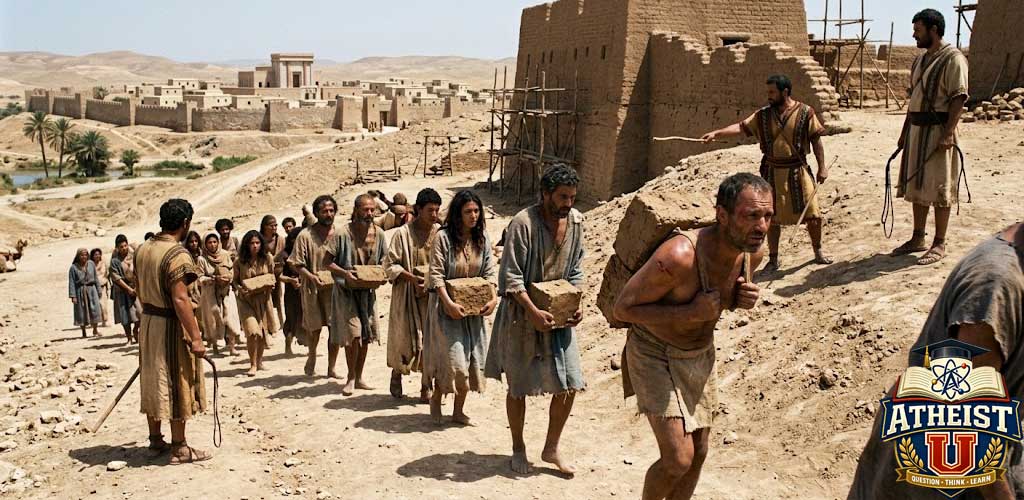
In the Old Testament, slavery appears mainly as part of an ancient social and economic system. Some people became servants because of debt, poverty, or war. For fellow Israelites, the law often treated this as temporary service rather than lifelong ownership. Exodus 21:2 says that a Hebrew slave was to serve six years and go free in the seventh. Deuteronomy 15:12 gives the same basic rule, and Deuteronomy 15:13-14 adds that the person should not be sent away empty-handed. They were to receive supplies so they could begin again.
That matters because it shows that the law was not simply saying, “Own people however you want.” It placed limits on the arrangement, especially among Israelites. Leviticus 25:39-43 also says that if a fellow Israelite became poor and sold himself into service, he was not to be treated harshly or like a slave, but more like a hired worker until the Year of Jubilee.
At the same time, the Old Testament does permit a harsher kind of slavery for foreigners. Leviticus 25:44-46 says Israelites could buy slaves from surrounding nations and pass them down as inherited property. That is one of the clearest passages showing that the Bible permits slavery in some form. It cannot honestly be explained away as simple employment or voluntary service. It establishes a framework for owning other human beings.
There are also difficult laws about physical punishment. Exodus 21:20-21 says that if a slave owner beat a slave and the slave died immediately, the owner was to be punished. But if the slave survived a day or two, the owner was not punished in the same way, because the slave was considered his property. To a modern reader, that is deeply troubling. It shows that the ancient law still accepted a hierarchy where some human beings could be treated as possessions.
Still, the Old Testament also contains protections that point in another direction. Exodus 21:26-27 says that if a master destroyed a slave’s eye or tooth, the slave was to go free. Deuteronomy 23:15-16 says an escaped slave was not to be returned to his master, but allowed to live freely in Israel. That is striking because many ancient societies punished people for harboring runaway slaves. The law did not abolish slavery, but it did not give slave owners unlimited power either.
The larger story of the Old Testament also complicates things. Israel’s defining memory was that they had been slaves in Egypt and that God had delivered them. The Exodus story is not a small side theme. It is central to Israel’s identity. Again and again, Israel is told to remember that they were slaves and to treat vulnerable people with compassion because of it. That memory sits uneasily beside the laws that allow slavery.
The New Testament has a similar tension. It was written in the Roman Empire, where slavery was widespread and built into the economy. The New Testament writers do not call for a political campaign to abolish slavery. Instead, they address slaves and masters as people already living inside that system.
That is why passages like Ephesians 6:5, Colossians 3:22, Titus 2:9, and 1 Peter 2:18 tell slaves to obey their masters. Those verses were later used by defenders of slavery, especially in the American South. Read by themselves, they sound like support for keeping slaves obedient.
But the New Testament also places slave and master under the same moral authority. Ephesians 6:9 tells masters to stop threatening their slaves and reminds them that both slave and master have the same Master in heaven. Colossians 4:1 tells masters to treat slaves justly and fairly. That does not abolish slavery, but it does challenge the idea that masters have absolute power.
The strongest New Testament challenge to slavery is not a law but a change in how people are told to see one another. Galatians 3:28 says there is “neither slave nor free” because all are one in Christ Jesus. That does not erase the social reality overnight, but it undercuts the spiritual logic of human hierarchy. If slave and master are equal before God, then the moral foundation of ownership begins to crack.
The letter to Philemon makes this personal. Onesimus, an enslaved man, had become connected to Paul. Paul sends him back to Philemon, but he tells Philemon to receive him “no longer as a slave, but better than a slave, as a dear brother” (Philemon 16). Paul does not directly command Philemon to free Onesimus, which is why the passage is debated. But he clearly pushes Philemon to see Onesimus in a new way. Once a man is your brother, it becomes much harder to treat him as property.
There is also 1 Timothy 1:10, which condemns slave traders or kidnappers. That matters because the transatlantic slave trade depended heavily on kidnapping, trafficking, and forced sale. Even if the Bible regulated slavery in the ancient world, that passage directly condemns the kind of human stealing that fueled much of later slavery.
So the most honest answer is this: the Bible permits and regulates slavery, but it also contains moral ideas that eventually worked against slavery. It does not give a clean abolitionist command in the way modern readers might wish. Leviticus 25:44-46, Exodus 21:20-21, Ephesians 6:5, and Colossians 3:22 show that slavery was accepted as part of the ancient world. But Genesis 1:27, the Exodus story, Deuteronomy 23:15-16, Luke 4:18, Galatians 3:28, Philemon 16, and 1 Timothy 1:10 point toward human dignity, liberation, equality, and the rejection of treating people as mere property.
That is why both slaveholders and abolitionists appealed to the Bible. Slaveholders focused on the passages that allowed slavery and commanded obedience. Abolitionists focused on the larger moral direction of Scripture: every person bears God’s image, God hears the cry of the oppressed, people are not spiritually ranked by social class, and love of neighbor cannot easily coexist with owning a neighbor.
In the end, the Bible reflects an ancient world where slavery was normal, but it also gives later readers the tools to question and reject that world. It regulates slavery in its laws and household instructions, yet its deeper themes move toward freedom, dignity, and equality before God.
The challenge is in reconciling a God who is eternal, does not change (Malachi 3:6), and is the source of absolute morality with a God who would permit perhaps the easiest question of morality in owning human beings to be viable.
Agree? Disagree?

