
 By: Joe Dyken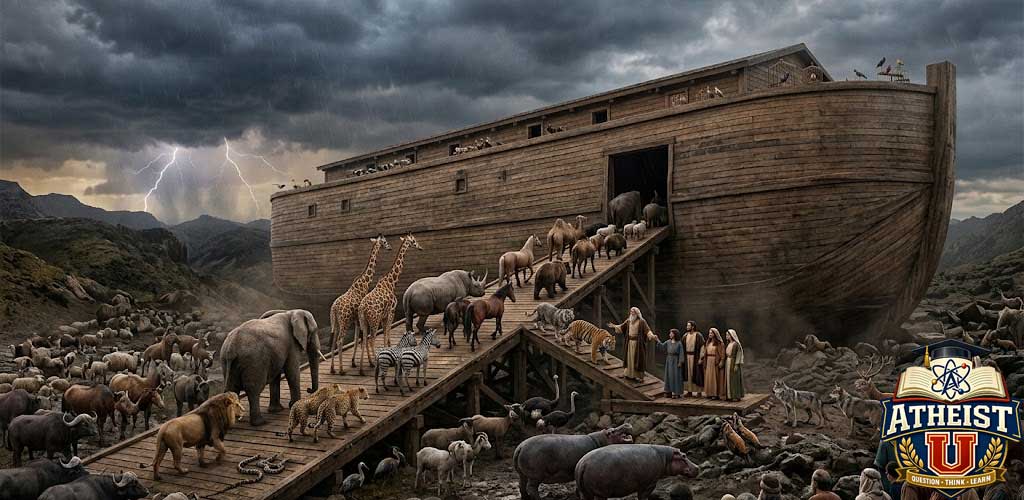
The story of Noah’s Ark is one of those ancient stories that still carries emotional and moral weight, but it becomes difficult to defend when treated as a literal account of world history.
From a scientific point of view, a global flood does not hold together. If the entire earth had been covered with water, especially high enough to cover the tallest mountains, there should be clear geological evidence of that kind of event. We would expect a massive worldwide layer of flood sediment, with plants, animals, and fossils mixed together in one chaotic deposit. That is not what the earth shows. Instead, geology points to long, gradual processes, layered over vast periods of time.
There is also the basic problem of water. The amount needed to cover every mountain on earth is far beyond what exists in the atmosphere, oceans, ice caps, or underground reservoirs. Even melting all the ice on earth would raise sea levels dramatically, but nowhere near enough to cover the highest peaks.
The Ark itself creates another problem. The size given in Genesis is enormous for a wooden ship. Large wooden vessels are prone to flexing, twisting, and leaking under heavy stress, especially in violent seas. Without modern materials and reinforcement, a wooden ship of that scale would be extremely difficult to keep seaworthy.
Then there is the animal question. Housing every land animal, feeding them, managing waste, keeping predators away from prey, providing special diets, and maintaining air flow would be impossible without constant miraculous intervention. The problem continues after the flood. If all animals spread out again from one location in the ancient Near East, we would expect to see clear migration trails in the fossil record. We do not. Animals like marsupials in Australia and sloths in South America make far more sense through normal biogeography than through a single post-flood migration from the Middle East. To date, we have not found native penguins in the Middle East.
That does not mean the story is meaningless. It likely grew out of a world where floods were terrifying and unforgettable. Ancient Mesopotamia, especially the land around the Tigris and Euphrates rivers, was vulnerable to sudden, destructive flooding. For people living on a flat plain, a massive regional flood could feel like the entire world had disappeared under water. That kind of trauma can become memory, then legend, then sacred story.
Flood stories were common in the ancient Near East. The Epic of Gilgamesh and the Atrahasis story include familiar elements: divine anger, a chosen survivor, a boat, animals, a devastating flood, and birds sent out to find land. The Noah story belongs in that larger world of ancient flood traditions, but it gives the story its own theological meaning.
The most difficult part of the story is not the boat. It is the moral question. What are we supposed to learn from a story where nearly all people and animals are destroyed? Genocide rarely has a positive upside from a morality perspective.
A shallow reading might say the lesson is simple: people were wicked, so God punished them. But that answer feels too easy. It avoids the horror of the story. Children die. Animals die. The whole world is wiped out. If we read that without discomfort, we are probably not reading it carefully enough.
A better reading sees the flood as a story about violence and the collapse of moral order. In Genesis, the world is not destroyed because people are merely annoying, noisy, or imperfect. The earth is described as being filled with violence. Human corruption has become so severe that creation itself seems broken. The flood is pictured as creation coming undone, as if the world is sliding back into chaos.
But the ending matters. The story does not end with destruction. It ends with a promise. God sees that human beings are still flawed, yet promises not to destroy the world by flood again. The rainbow becomes a sign of restraint. The story moves from judgment to covenant, from destruction to preservation.
That shift is important. The flood does not fix human nature. Noah survives, but humanity does not suddenly become pure. The story seems to admit that wiping the slate clean does not solve the deeper problem. People remain morally fragile. So the future cannot be built on endless destruction. It has to be built on patience, law, mercy, and covenant.
This is where the story’s deeper meaning comes through. It is not a scientific report about geology, shipbuilding, or animal migration. It is an ancient theological story about a world ruined by violence, a terrifying judgment, and a new beginning grounded in restraint. Its moral center is not the flood itself, but what comes after: the promise that destruction will not be the final answer.
So the most responsible way to read the story is to be honest about both sides. As literal history, it does not fit the evidence. As a moral and religious story, it wrestles with questions that still matter: What happens when violence fills the world? Can humanity begin again? Is judgment enough? What limits should even divine power accept?
The answer the story gives is sobering. Violence destroys the world. Judgment alone does not heal it. A livable future depends on mercy, restraint, and a renewed commitment to the value of life.
In short, the story of Noah's Ark is not scientifically plausible no matter how hard someone might try to reduce the number of species on the ark, feed the animals, take care of the animals, and make the ark suitable for caring for them for an extended period of time.
Agree? Disagree?

