
 By: Joe Dyken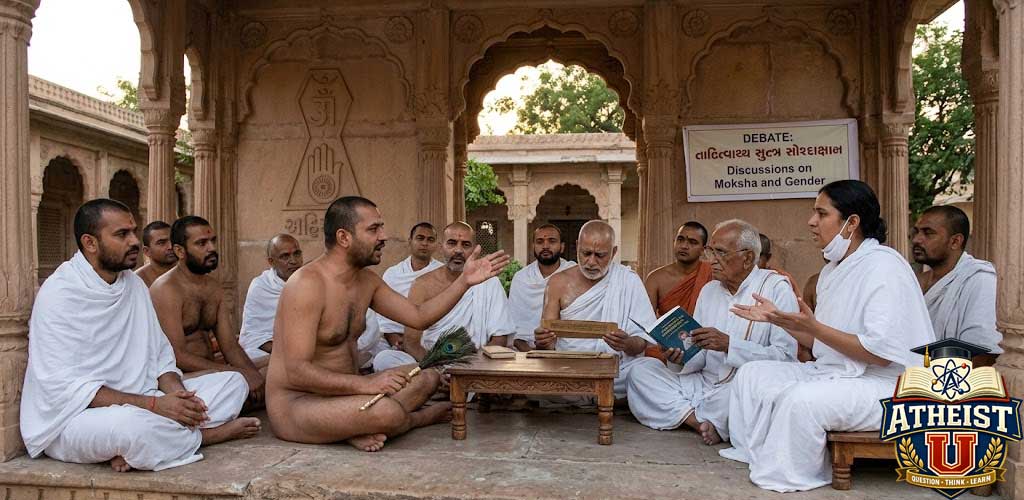
In Jainism, the question of whether women can attain moksha has a simple answer at first, but a more complicated answer once the major Jain traditions are considered.
At the heart of Jain thought is the belief that every living soul, or jiva, has the potential for liberation. Moksha means complete freedom from karma, rebirth, and suffering. It is not granted by a god, and it is not based on wealth, caste, status, or social position. It comes through spiritual discipline, nonviolence, right faith, right knowledge, and right conduct.
From that broad perspective, women are not spiritually inferior. Both major Jain traditions agree that women have souls and can make serious spiritual progress. The disagreement is more specific. It centers on whether a woman can attain final liberation directly from a female body.
The Svetambara tradition says yes. For Svetambaras, the soul itself has no gender. Gender belongs to the body, not to the deepest spiritual self. Since moksha is the liberation of the soul, a female body does not prevent someone from reaching the highest spiritual state. What matters most is inner purity, detachment, discipline, and the removal of karma.
This view also explains why Svetambaras accept the possibility of a female Tirthankara. A Tirthankara is a perfected teacher who rediscovers and teaches the path to liberation. Svetambaras identify the nineteenth Tirthankara, Mallinatha, as female. For them, Mallinatha serves as a powerful example that a woman can reach omniscience and liberation.
The Digambara tradition takes a different position. Digambaras also believe women have souls and can advance spiritually, but classical Digambara teaching holds that women cannot attain moksha directly from a female body. Instead, a woman can live a deeply disciplined life, gain spiritual merit, and be reborn as a man, after which final liberation becomes possible.
The reason for this view is tied to Digambara ideas about complete renunciation. Digambara monks practice total nudity as a sign of absolute non-possession. To them, giving up clothing is not just symbolic. It represents the highest level of detachment from worldly things. Since women are not permitted to practice nude asceticism in the same way, Digambara thinkers argued that women cannot fulfill the final requirements needed for moksha in that lifetime.
This difference is not really a debate over whether women matter spiritually. Both traditions take female religious life seriously, and Jain communities have long included large numbers of nuns. In many periods, nuns have even outnumbered monks. Women have been teachers, renunciants, patrons, and important members of Jain religious communities.
The real debate is about the relationship between the body and liberation. Svetambaras place the emphasis on the genderless nature of the soul and argue that clothing or biological sex does not block liberation. Digambaras place more emphasis on the physical conditions of the most advanced ascetic life and argue that those conditions cannot be fully met in a female body.
That is why the question has two answers. In Svetambara Jainism, women can attain moksha directly. In Digambara Jainism, women can progress toward moksha, but must first be reborn as men before attaining final liberation.
So the broader Jain idea is that every soul has the potential to be free. The sectarian disagreement is over whether that freedom can be completed while the soul is living in a female body. This makes the issue one of the most important debates in Jainism, not because women are denied spiritual seriousness, but because Jain traditions have disagreed over what the final stage of renunciation requires.
Agree? Disagree?

