
 By: Joe Dyken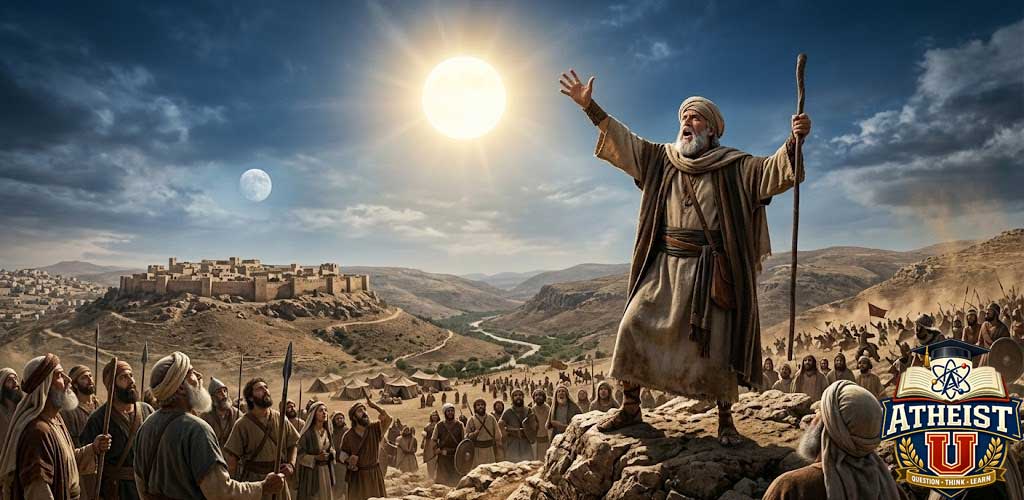
The story of Joshua commanding the sun to stand still is one of the most dramatic moments in the Hebrew Bible. It appears during a desperate battle in Joshua 10, when Israel is fighting a coalition of five Amorite kings. These kings had attacked Gibeon after Gibeon made peace with Israel, so Joshua marched his army through the night from Gilgal to come to Gibeon’s defense.
The surprise attack works. The Amorite forces are thrown into panic and begin fleeing down the difficult road near Beth-horon. The battle already has the feel of something larger than ordinary warfare. The text says that God sends a violent hailstorm against the fleeing army, and more of the enemy die from the hail than from Israel’s swords. In other words, the victory is not presented as Joshua’s achievement alone. The story wants the reader to see God actively fighting for Israel.
Then comes the famous moment. Joshua speaks in front of Israel and says, “Sun, stand still over Gibeon, and moon, over the Valley of Aijalon.” The text says the sun stopped in the middle of the sky and delayed going down until Israel completed its victory. Later tradition has sometimes tried to calculate this as roughly fourteen extra hours of daylight, although the biblical wording itself is more general. It says the sun did not hurry to set for about a whole day.
Taken at face value, the scene is breathtaking. Joshua needs more time to finish the battle before darkness allows the enemy to scatter, hide, and regroup. So he asks for the impossible. Nature itself pauses so the victory can be completed. The point is not just that Israel wins. The point is that the God of Israel has authority over weather, armies, kings, the sun, and the moon.
From a modern scientific standpoint, however, a literal stopping of the sun creates serious problems. The sun does not actually travel across the sky in the way it appears to us from Earth. That movement is caused by the rotation of the Earth. So if the sun appeared to stop in the sky for many hours, the Earth itself would have had to stop rotating or slow dramatically.
That would be catastrophic under normal physical laws. The Earth rotates at tremendous speed, especially near the equator. If that motion suddenly stopped, the atmosphere, oceans, and everything not firmly attached to the planet would continue moving. The result would likely be worldwide destruction through massive winds, tsunamis, earthquakes, and other violent effects. Restarting the rotation would create another set of impossible physical problems. There is also no clear independent record from surrounding ancient civilizations of a worldwide “long day” event.
That is why interpreters have taken the passage in several different ways.
Some read it as a literal miracle. In that view, scientific objections do not settle the matter because the event is not being presented as a normal natural occurrence. If God created and sustains the universe, then God could also suspend or override ordinary physical laws. For believers who take this approach, the lack of scientific plausibility is not a problem. The whole point is that this was a unique act of divine intervention.
Others read the passage as poetic or heroic battle language. The text refers to the Book of Jashar, which appears to have been an ancient collection of Israelite poetic or heroic material. Ancient war accounts often used cosmic language to describe overwhelming victory. In that sense, “the sun stood still” may not be intended as a technical astronomical claim. It may mean that the day of victory felt extraordinary, that Joshua accomplished more than seemed possible, or that the battle was so decisive it was remembered in cosmic terms.
Another possibility focuses on the Hebrew language. The word often translated “stand still” can also carry meanings like “be silent,” “cease,” or “wait.” Some scholars have suggested that Joshua may not have been asking for more sunlight, but for relief from the sun’s heat or glare. Since the same chapter describes a violent hailstorm, the image could involve storm clouds darkening the sky and making the sun “silent.” That reading does not fit every detail easily, but it shows that the Hebrew wording may be more flexible than a simple English translation suggests.
There are also attempts to connect the story to an eclipse, atmospheric effect, unusual refraction of light, or an omen involving the sun and moon. These theories are interesting, especially because ancient peoples often saw celestial events as signs related to kings, battles, and divine favor. Still, none of these explanations fully matches the plain impression of the story, which describes an extraordinary delay in the setting of the sun.
The best way to understand the passage may be to start with its ancient setting rather than with modern physics. In the ancient world, battles were not viewed as purely political or military events. Weather, celestial bodies, kingship, land, and divine power were all connected. A battle could reveal which god ruled, which people had favor, and which king had legitimacy. So when the story says the sun and moon obeyed Joshua’s command, it is making a theological claim: Israel’s God is sovereign not only over Israel, but over creation itself.
So the story works on more than one level. As a strict scientific claim that the Earth stopped rotating for hours, it is not plausible under natural law. As a miracle claim, it depends on whether one accepts the possibility that God can act beyond ordinary physical processes. As literature, it is a powerful victory account. As theology, it declares that Joshua’s triumph was not simply the result of courage, strategy, or military strength. It was remembered as a day when heaven and earth stood behind Israel’s cause.
Agree? Disagree?

