
 By: Joe Dyken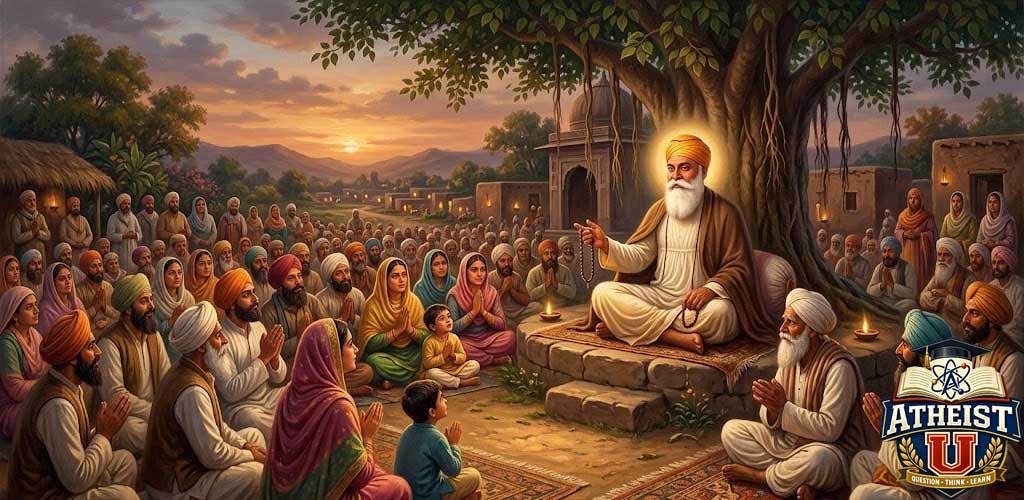
Guru Nanak probably did not think of himself as “starting a new religion” in the way people use that phrase today. He was not creating a modern institution with formal membership, fixed boundaries, and a label meant to compete with Hinduism and Islam. But he was doing something much bigger than simply offering a few reforms. He was laying out a distinct path of spiritual life, and that path became Sikhism.
He lived in Punjab during a time when religious identity carried real social and political weight. Hindu traditions, Islamic rule, Sufi spirituality, Bhakti devotion, caste divisions, ritual practices, and community tensions all shaped the world around him. In that environment, Nanak’s message was bold. When he said, “There is no Hindu, there is no Muslim,” he was not denying that those communities existed. He was challenging the idea that a religious label, by itself, made a person truthful, holy, or close to God.
For Nanak, the real test of religion was not what someone called themselves. It was how they lived. Did they remember the One God? Did they act with humility? Did they earn honestly? Did they share with others? Did they treat people equally? Did they reject pride, empty ritual, and social cruelty? Those questions mattered more to him than inherited identity.
That is why it is too simple to say he was only blending Hinduism and Islam. He used words and ideas familiar to his time, but he gave them a new center. His teaching focused on one formless God, direct devotion, honest work, service, equality, and truthful living. He rejected caste hierarchy, religious hypocrisy, hollow ritual, and the idea that priests, scriptures, or social rank could control access to the Divine.
It is also too simple to call him only a reformer. Reformers usually work inside an existing system. Nanak did criticize the religious systems around him, but he also built something of his own. He gathered followers. He composed hymns. He created a disciplined way of life. He founded a community at Kartarpur where people worshiped together, worked, shared meals, and lived out his teachings in practical ways.
The community meal, or langar, was especially important. It was not just charity. It was a direct challenge to caste and status. Everyone sat together and ate together. Rich and poor, high caste and low caste, men and women, all shared the same food in the same space. That turned a spiritual idea into a social reality.
One of the clearest signs that Nanak intended his path to continue was his choice of a successor. If his work had been only personal teaching or private mysticism, it could have ended with him. Instead, he chose Guru Angad to carry the mission forward. That act gave the movement continuity, authority, and direction. It showed that Nanak’s path was not meant to disappear after his death.
The later Gurus developed that foundation further. They strengthened the community, preserved the hymns, shaped Sikh identity, and eventually gave the tradition more formal structure. Guru Arjan compiled the Adi Granth. Guru Hargobind deepened the relationship between spiritual and worldly responsibility. Guru Gobind Singh later established the Khalsa, giving Sikh identity an even clearer public form.
So the fairest answer is this: Guru Nanak did not likely set out to create a “new religion” in the modern institutional sense. But he clearly began a new spiritual community with its own teachings, practices, values, and leadership. He was not merely trying to repair Hinduism or Islam, and he was not simply mixing the two. He was calling people to a different way of living before God and with one another.
In plain terms, Guru Nanak planted the seed. The later Gurus helped it grow. What began as the Guru’s path became Sikhism.
Agree? Disagree?

