
 By: Joe Dyken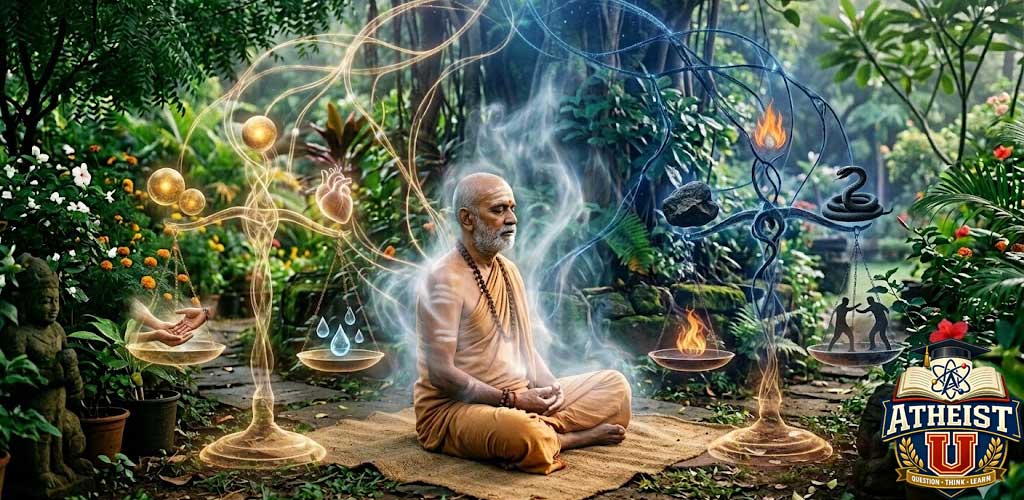
Karma is one of the most important ideas in Hindu thought, but it is easy to misunderstand. In everyday conversation, people often use karma to mean “what goes around comes around.” That captures part of the idea, but the traditional concept is deeper than that. Karma is not simply luck, revenge, or a universe handing out instant rewards and punishments. It is a way of explaining how actions, intentions, habits, and moral choices shape a person’s future.
In Hindu traditions, karma means “action” or “deed.” The basic idea is that what people do matters. Good actions, harmful actions, selfish desires, duties, and intentions all leave consequences. These consequences may shape a person’s character, relationships, future experiences, and, in many Hindu schools, future rebirths. Karma is closely tied to samsara, the cycle of birth, death, and rebirth, and to moksha, liberation from that cycle.
Historically, karma helped answer some of life’s hardest questions. Why do people suffer? Why are people born into such different circumstances? Why should someone act morally if no one is watching? Karma offers one religious answer: life is part of a larger moral order, and the results of action may extend beyond what can be seen in one lifetime.
That does not mean karma is scientifically proven. If karma means that actions have ordinary consequences, then it is easy to see evidence for it. Cruelty can damage trust. Generosity can strengthen relationships. Discipline can shape character. Anger can create stress and conflict. Kindness can build goodwill. In that practical sense, karma is very real because choices affect people, families, communities, reputations, and habits.
But if karma means a cosmic moral law that tracks every action and guarantees reward or punishment across lifetimes, then the evidence is much weaker. That version depends on ideas that science has not confirmed, including rebirth, the survival of consciousness after death, and some unseen mechanism that connects moral actions to future events. Those claims may be meaningful within religion and philosophy, but they are not testable in the same way as gravity, biology, or medicine.
This is where the distinction matters. Karma can be powerful as a moral and spiritual framework without being scientifically demonstrated as a literal force. Science generally looks for claims that can be measured, tested, repeated, and potentially proven wrong. A cosmic system of karma is difficult to test because it often involves past lives, invisible causes, and outcomes that cannot be separated clearly from chance, environment, genetics, social systems, or personal decisions.
There is also a serious ethical concern. When karma is applied too rigidly, it can become a way to blame people for their suffering. Poverty, illness, injustice, or tragedy can be wrongly explained as something a person must have deserved. That can lead to indifference instead of compassion. Many thoughtful Hindu interpretations avoid this by emphasizing dharma, charity, self-discipline, compassion, and responsibility. Karma should not be used as an excuse to ignore suffering.
The strongest modern way to understand karma is as a moral psychology. What people do changes the world around them, but it also changes them. Repeated anger can make someone more bitter and reactive. Repeated dishonesty can make trust harder to maintain. Repeated kindness can make compassion more natural. Habits become character, and character influences future choices. In that sense, karma does not require a mystical ledger. The consequences are already visible in the mind, body, and community.
Social life also gives karma a practical form. People remember how others treat them. A person who is generous, fair, and dependable often builds trust and support. A person who is cruel or selfish may face suspicion, isolation, or retaliation. These outcomes are not guaranteed, and life is not always fair, but actions often create patterns that shape future experience.
So the fairest conclusion is this: karma is not best understood as a scientific theory. It is a religious, philosophical, and ethical framework for making sense of action and consequence. There is strong everyday evidence that choices shape character, relationships, and future outcomes. There is not strong scientific evidence proving a cosmic moral law that carries rewards and punishments across lifetimes.
Karma remains powerful because it teaches that human action matters. It asks people to take responsibility for what they do, how they think, and what they become. Even for someone who does not accept rebirth or a spiritual moral order, karma can still offer a useful insight: our actions do not disappear. They leave marks on others, on the world, and on ourselves.
Agree? Disagree?

