
 By: Joe Dyken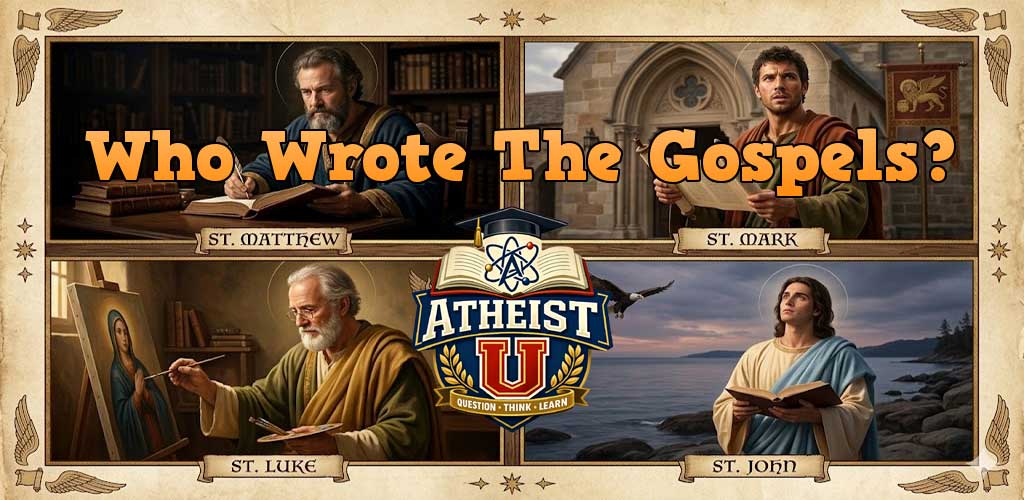
The four Gospels - Matthew, Mark, Luke, and John - stand at the center of the New Testament, but one of the more interesting historical questions is whether the men whose names appear in the titles actually wrote them. The traditional Christian answer is familiar: Matthew was the tax collector and one of Jesus’ twelve disciples; Mark was a companion of Peter; Luke was a companion of Paul and a physician; and John was the beloved disciple, usually identified as John the son of Zebedee. Those names have been attached to the Gospels for many centuries and became firmly established in the early church by the late second century.
The difficulty is that the Gospels themselves do not identify their authors. None of them begins the way some of Paul’s letters do, with a direct statement such as, “I, Matthew, am writing this.” Instead, the Gospels are written anonymously and in the third person. Matthew, for example, does not present himself as an eyewitness describing what he personally saw. Luke doesn't even pretend that he was an eyewitness. He opens his Gospel by saying that he has carefully investigated earlier accounts and traditions, which suggests that he is working from sources rather than writing as a direct eyewitness. John’s Gospel refers to “the disciple whom Jesus loved,” but it never clearly says that this disciple is the author, nor does it name him as John. That connection was made later through church tradition.
The traditional titles, such as “According to Matthew” or “According to John,” were likely added after the Gospels had already begun circulating. As Christian communities collected and copied these writings, titles became necessary to distinguish one account from another. By the second century, the names Matthew, Mark, Luke, and John were widely associated with the four canonical Gospels. Early Christian writers such as Papias and Irenaeus helped preserve and defend those associations. Papias, writing in the early second century, claimed that Mark wrote down Peter’s preaching and that Matthew compiled sayings of Jesus in a Hebrew or Aramaic form. Irenaeus, later in the second century, presented the fourfold Gospel tradition as authoritative and tied each Gospel to the names still used today.
Modern scholarship generally takes a more cautious view. Most scholars agree that the Gospels were originally anonymous and that the names attached to them reflect later tradition rather than self-identification by the authors. Mark is usually considered the earliest Gospel, written around 65–70 CE, and is commonly viewed as a source used by both Matthew and Luke. Matthew and Luke are usually dated around 80–90 CE, while John is often dated around 90–100 CE. Since these works were written decades after Jesus’ death and in polished Greek, many scholars believe they were composed by educated later Christians who drew on oral traditions, written sources, and the memories preserved within early Christian communities.
That does not mean the traditional names are meaningless. They show how the early church understood the authority behind these texts. Mark was connected to Peter, Luke to Paul and other eyewitness traditions, and Matthew and John to apostolic circles. In other words, the titles may reflect the perceived source or authority behind each Gospel more than the literal person who sat down and wrote the final version. This is especially important with Mark and Luke, because neither was traditionally counted among the twelve disciples. If the church had simply wanted to invent impressive authorship claims, it could have attributed all four Gospels directly to apostles. The fact that Mark and Luke were preserved under non-apostolic names suggests that the traditions may preserve some older memory about the origins of those writings.
Matthew presents a more complicated case. Tradition identifies the author as the apostle Matthew, but the Gospel itself is written in Greek and appears to rely heavily on Mark. Since Mark was not an eyewitness, many scholars find it unlikely that an apostle who had personally followed Jesus would depend so extensively on Mark’s account. For that reason, the Gospel of Matthew is often understood as the work of an unknown Jewish-Christian author or community that used Mark, sayings traditions, and other material to present Jesus as the fulfillment of Israel’s Scriptures.
Luke is somewhat different because the author openly acknowledges using earlier sources. He does not claim to have witnessed Jesus’ ministry firsthand. Instead, he presents himself as someone who has investigated the traditions handed down by eyewitnesses. The same author also wrote Acts, and early tradition identifies him as Luke, the physician and companion of Paul. Many scholars are willing to see this tradition as plausible, though they still regard Luke as a second-generation Christian rather than one of Jesus’ original disciples.
John is perhaps the most debated. The Gospel connects itself to the testimony of the “beloved disciple,” but it does not clearly identify that disciple. Later tradition equated him with John the son of Zebedee, but modern scholars are divided. Some think the Gospel may preserve the testimony of an actual disciple or a community shaped by such a figure. Others believe the beloved disciple may be a literary figure, an unknown follower of Jesus, Lazarus, John the Elder, or someone else entirely. What most agree on is that the final form of John likely reflects a developed theological tradition rather than a simple firsthand memoir.
So the fairest summary is this: the Gospels are formally anonymous, and there is no direct internal evidence proving that Matthew, Mark, Luke, or John personally wrote the texts as we now have them. The names come from early Christian tradition, not from the documents themselves. At the same time, those traditions are historically important because they show how early Christians connected these writings to apostolic authority and trusted lines of testimony.
In academic study today, the dominant view is that none of the Gospels was written directly by one of Jesus’ original disciples in the simple traditional sense. Mark is usually seen as a Gospel connected with Peter’s preaching; Matthew as the work of an unknown Jewish-Christian author using earlier sources; Luke as an educated second-generation Christian associated by tradition with Paul; and John as a Gospel emerging from the circle or testimony of the beloved disciple, whose exact identity remains uncertain.
The issue, then, is not whether the Gospels are valuable or influential. They plainly are. The question is what kind of writings they are. Historically speaking, they are best understood as anonymous theological narratives rooted in earlier traditions about Jesus, later attached to authoritative names by the early church. It's reasonable to conclude that nobody who physically wrote about Jesus ever actually met him.
Agree? Disagree?

